Introduction
A 5 kW inverter on a 10 kW solar array may sound undersized, especially on a south-facing roof where the panels are much more likely to peak together around midday. However, it may be surprising to learn actually how little difference it makes for the return on investment.
This model compares the same 9.9 kW south-facing array, battery, tariff, and household demand with two different inverter sizes to show how much annual value is really lost by choosing the smaller inverter.
The result is that the larger inverter does better, but the difference is modest in annual cash terms: about 464 kWh/year more export and about £56/year more total benefit.
The main assumption is based on the household not having really power hungry devices like power-showers which can consume more than 5 kW (or that these devices are used infrequently).
These reports were modelled using our solar calculator: open the free Solar Butter solar calculator, which is free to use with no sign up required.
Assumptions
- 20 DMEG 495 W panels on a single south-facing roof, about 9.9 kW total array size
- 10 kWh battery storage
- 5,500 kWh/year household electricity demand
- Fixed tariff: 28p import, 12p export, 60p/day standing charge
- The two reports use the same roof, battery, tariff, demand, and weather-year assumptions
- The only intended change between the two scenarios is inverter size
- A 10 kW array on a 5 kW inverter is a DC/AC ratio of 2.0, which is high and should only be considered where the exact inverter datasheet explicitly allows it
The simulation uses hour-by-hour averaged weather data rather than second-by-second cloud movement, so real clipping on the brightest days may differ slightly from the model. The report also assumes that no high-load devices are present such as power showers, as a larger inverter would give additional benefit in these instances. It is always best to check peak-load in any household and it's frequency/ duration.
It also should be noted that not any 5 kW inverter can accept a 10 kW array. In fact most cannot. It is absolutely required to check individual inverter parameters to check suitability. Most inverters might only accept a DC/AC oversizing factor of 1.3. This example uses a factor of 2 as some inverters support it.
Scenario 1: 10 kW array with 5 kW inverter
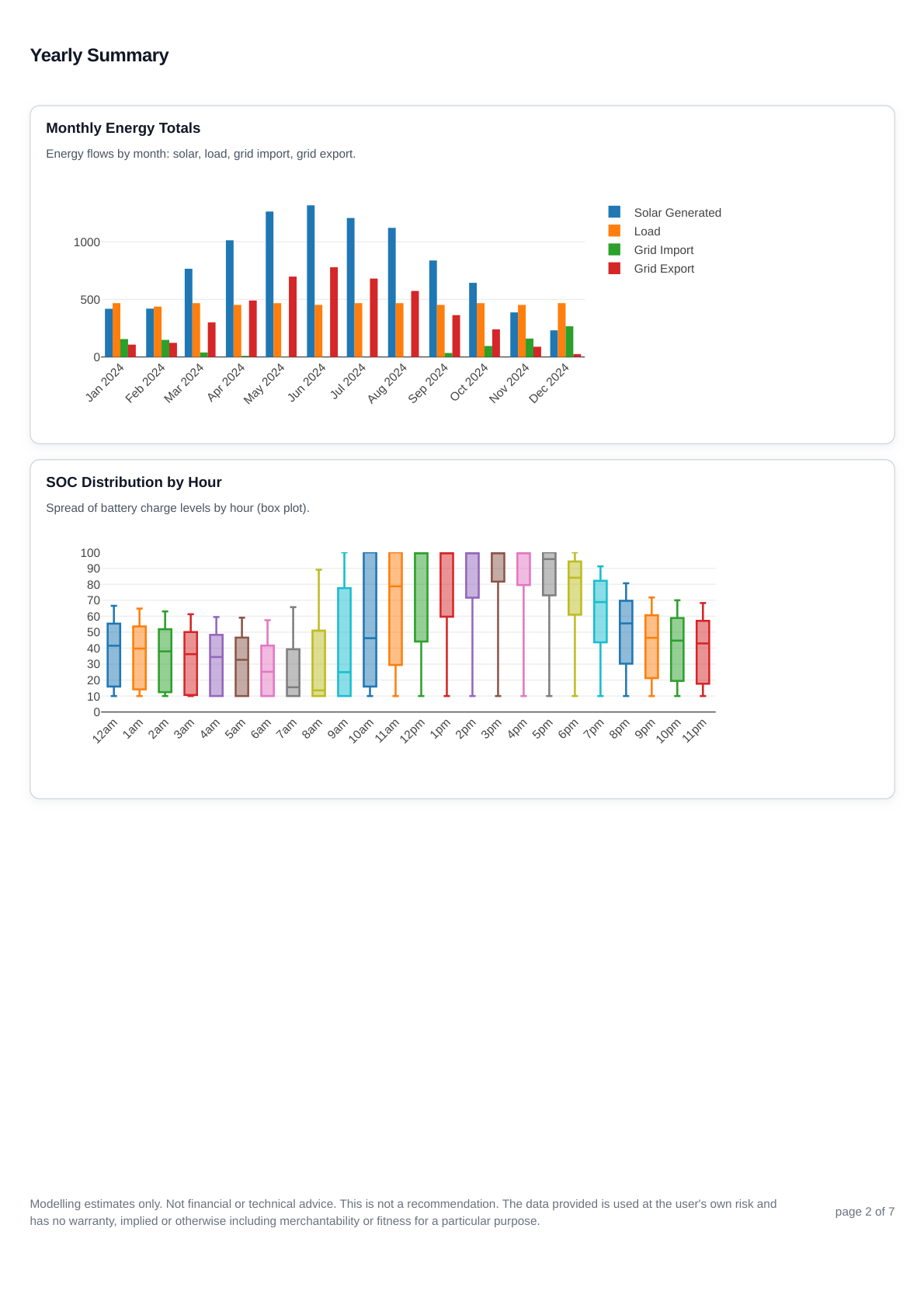
Outputs
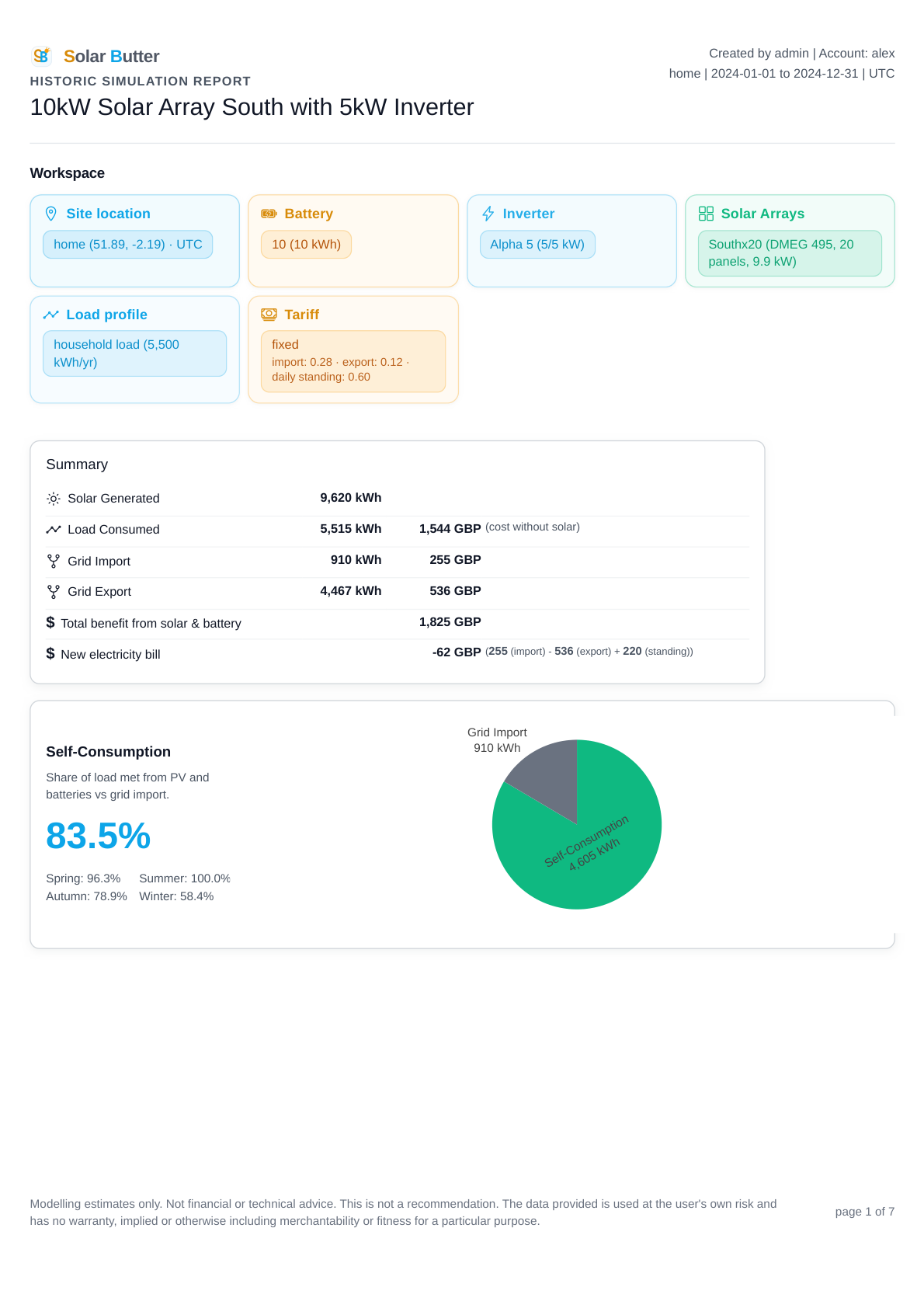
- 9,620 kWh annual solar generation
- 910 kWh grid import
- 4,467 kWh grid export
- 4,605 kWh self-consumed from PV and battery
- 83.5% of annual load met by PV and battery
- About £1,825/year total benefit from solar and battery
- Modelled electricity bill of about -£62/year
This is already a strong result. The smaller inverter does not change the economics, because the household still gets a lot of direct solar use and a lot of the daily energy is used to charge the battery. This corresponds to a very low annual import.
Scenario 2: 10 kW array with 10 kW inverter
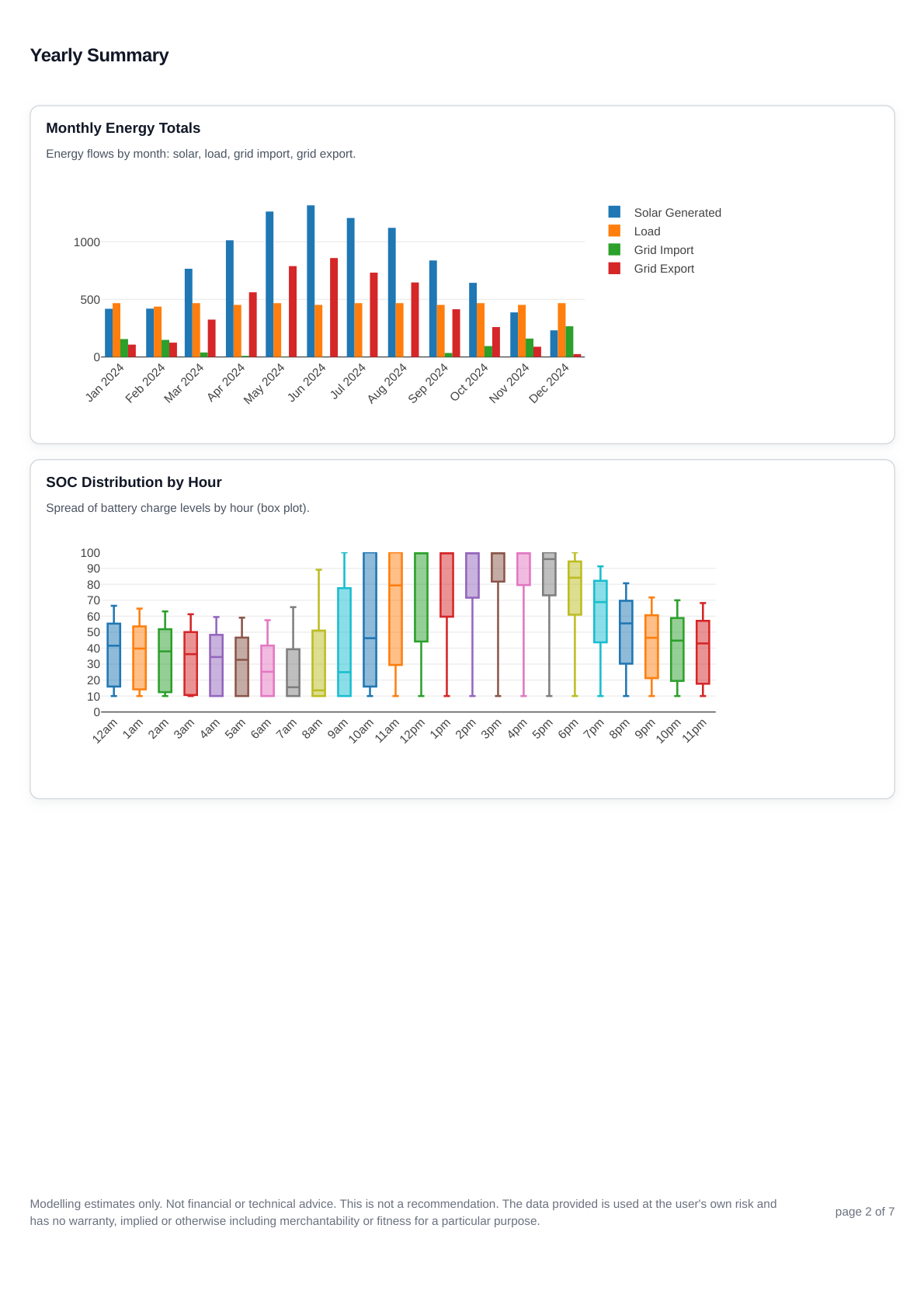
Outputs
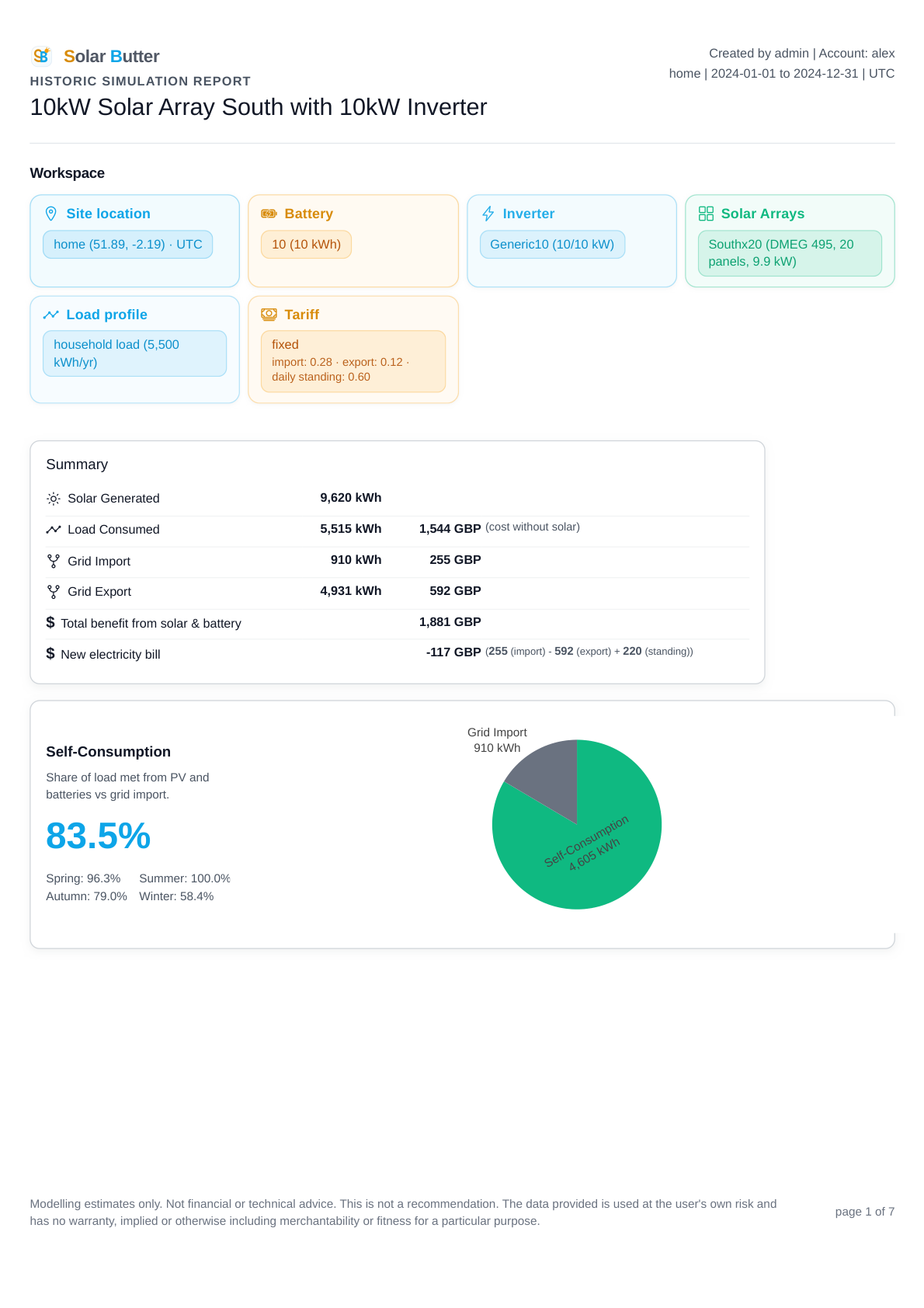
- 9,620 kWh annual solar generation
- 910 kWh grid import
- 4,931 kWh grid export
- 4,605 kWh self-consumed from PV and battery
- 83.5% of annual load met by PV and battery
- About £1,881/year total benefit from solar and battery
- Modelled electricity bill of about -£117/year
Comparison
£1,825/year benefit
9,620 kWh generated, 910 kWh imported, 4,467 kWh exported.
£1,881/year benefit
9,620 kWh generated, 910 kWh imported, 4,931 kWh exported.
About £56/year
The larger inverter adds about 464 kWh/year of export in this model.
The bigger inverter clearly does better on this roof than it did in the east-west comparison. That makes physical sense. A single south-facing array tends to pile more production into the same sunny midday periods, so there is more opportunity for a smaller inverter to clip the top of the power curve.
Even so, the annual gap is still not dramatic. Self-consumption stays the same at 4,605 kWh/year and the difference appears mainly as extra export revenue, not as a transformation in how the home operates day to day. This is because the model does not account for any large peaks in demand, it is hourly averaged. It is always recommended that the reader should check their specific peak demand to be certain the results will align with them.
| Scenario | Solar generated | Grid import | Grid export | Self-consumed solar | Export income | Total benefit | New bill |
|---|---|---|---|---|---|---|---|
| 5 kW inverter | 9,620 kWh | 910 kWh | 4,467 kWh | 4,605 kWh | £536/year | £1,825/year | -£62/year |
| 10 kW inverter | 9,620 kWh | 910 kWh | 4,931 kWh | 4,605 kWh | £592/year | £1,881/year | -£117/year |
Install?
For this exact system, the 5 kW inverter still performs well and the payback time for the whole install is only very slightly affected. But it is less convincing than it was on the east-west roof. A south-facing array creates the kind of midday peak where a larger inverter can recover more export and a little more annual value.
The key question is cost difference. If moving from the 5 kW inverter option to the 10 kW option only costs a few hundred pounds, it may be worthwhile because the annual benefit is about £56 higher. If the upgrade is expensive, the extra ROI may take a long time to recover.
So the smaller inverter does hurt return on investment slightly for this south-facing roof, but not by enough to transform the project economics on its own.