Introduction
This case looks at whether spending about £4,000 on two extra Fox EP12 batteries makes financial sense for a home that already has two EP12 batteries, roughly 10,000 kWh/year of solar generation, and a 3.68 kW inverter.
The household already uses about 8,200 kWh/year and plans to add a heat pump, so the extra batteries are mainly about shifting more cheap off-peak electricity into winter heating.
The inverter is limited to charge at 3.6 kW so the batteries cannot charge anymore than they do in the allocated charge window.
These reports were modelled using our solar calculator: open the free Solar Butter solar calculator, which is free to use with no sign up required.
Baseline Model
Assumptions
- No electric vehicle (no access to very low rate electrity on EV tariff)
- Assumed tariff is a heat pump tariff with multiple off-peak periods through the day
Inputs
- 8,200 kWh/year base household electricity demand
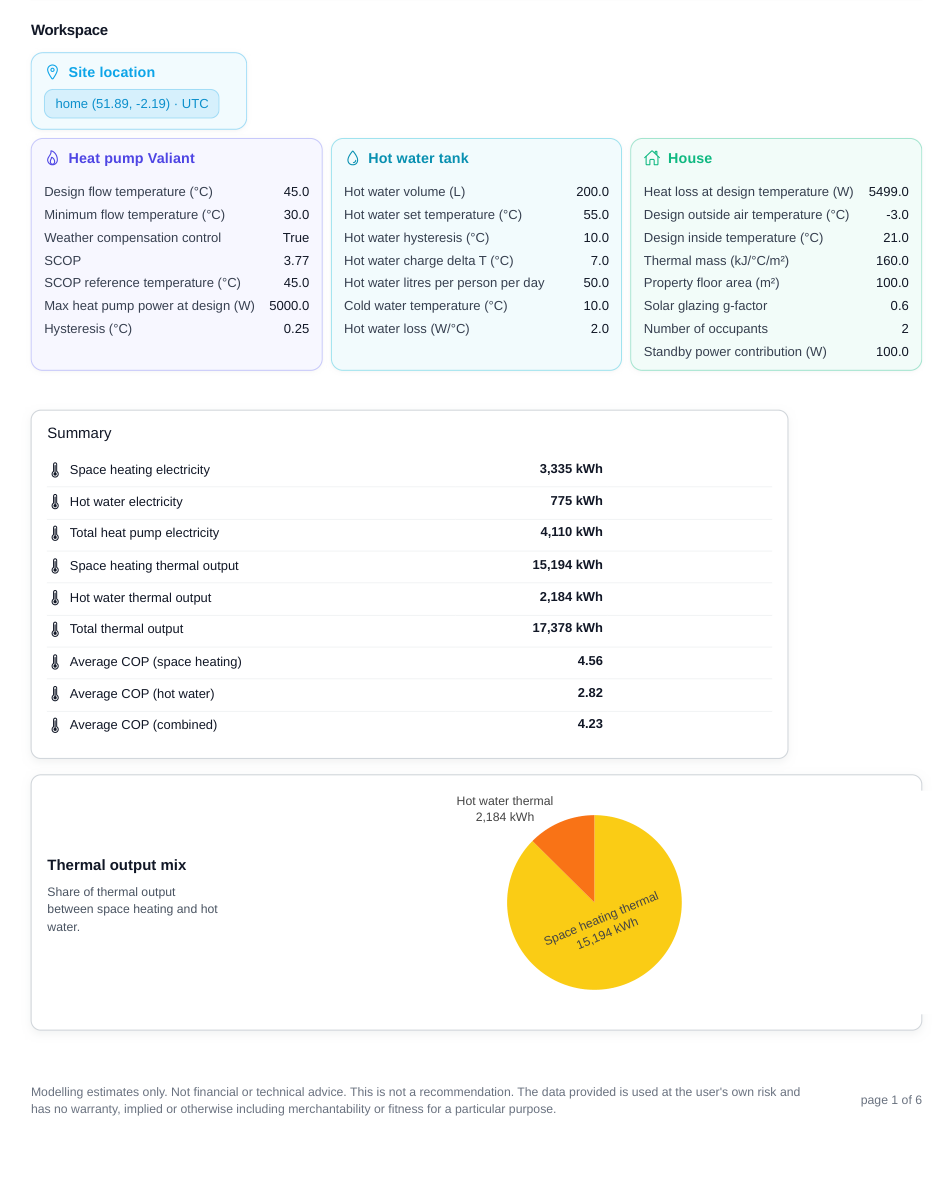
- Planned heat pump with 3,335 kWh for space heating and 775 kWh for hot water
- Vaillant heat pump model showing 4,110 kWh/year total heat-pump electricity demand
- 17,378 kWh/year total thermal output from the heat pump model
- Heat pump tariff (cosy)
- Modelled electricity cost without solar or battery help is about £3,096/year + £220/year standing charge
Outputs
- 12,333 kWh annual electricity consumption once the heat pump is included
- 4,110 kWh/year of that load comes from the heat pump
- About £3,096/year + £220/year standing cost without solar in the paired simulation
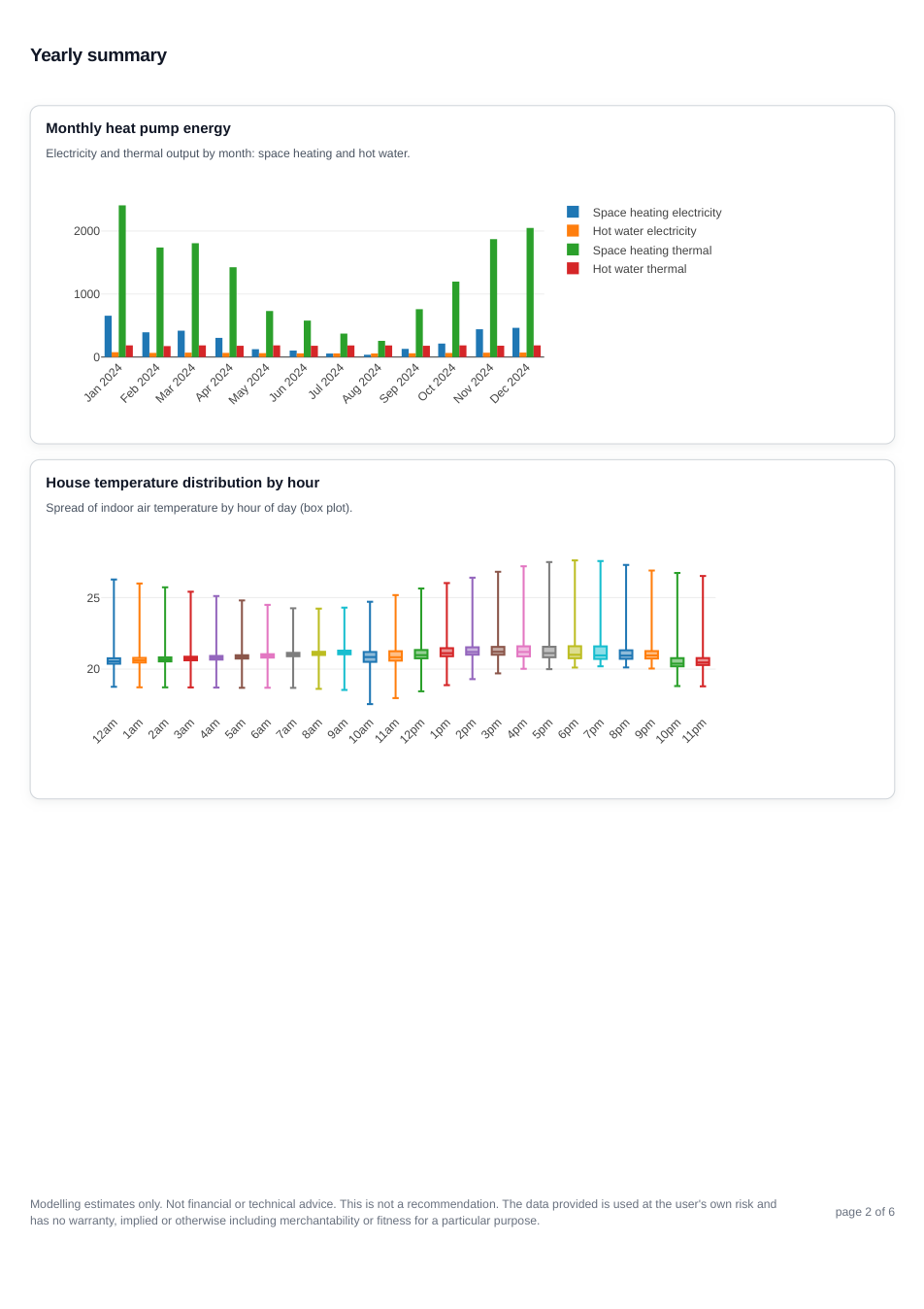
- High winter electricity demand is the reason battery charging strategy matters
Optimisation Model
Inputs
- 2 x Fox EP12 batteries, shown in the report as about 23 kWh total storage
- Fox ESS H1-3.6-E hybrid inverter with 3.6 kW import and export power
- 22 south-facing Jinko Tiger Neo 445 W panels, about 9.8 kW total PV
- Same 8,200 kWh household demand plus the modeled heat-pump load
- Octopus Cosy charging twice a day with 12p export
- 3.68 kW export-limited site, so excess solar is already encouraged into the battery
Outputs
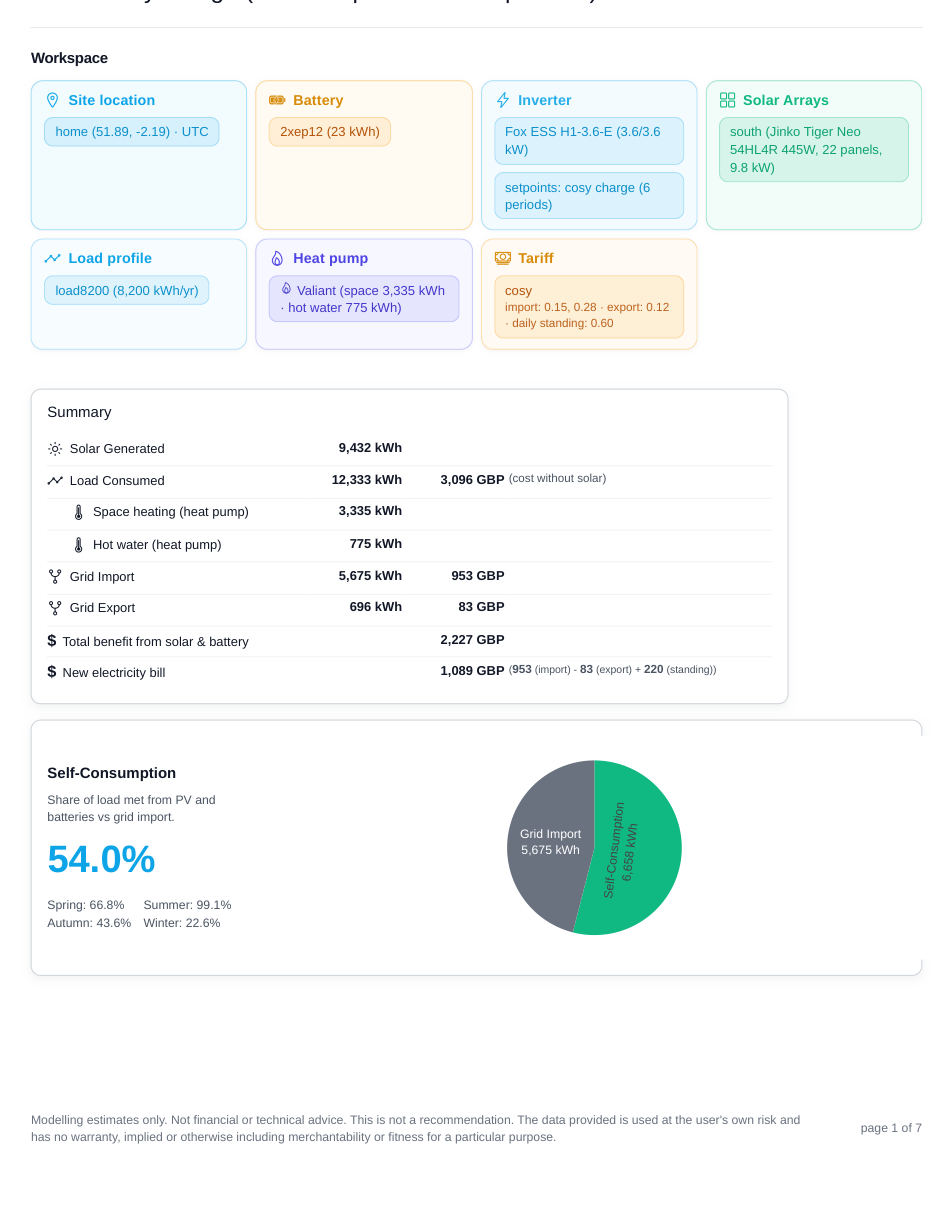
- 9,432 kWh annual solar generation
- 12,333 kWh annual load once the heat pump is included
- 5,675 kWh grid import and 696 kWh grid export
- 54.0% of annual load met by PV and batteries
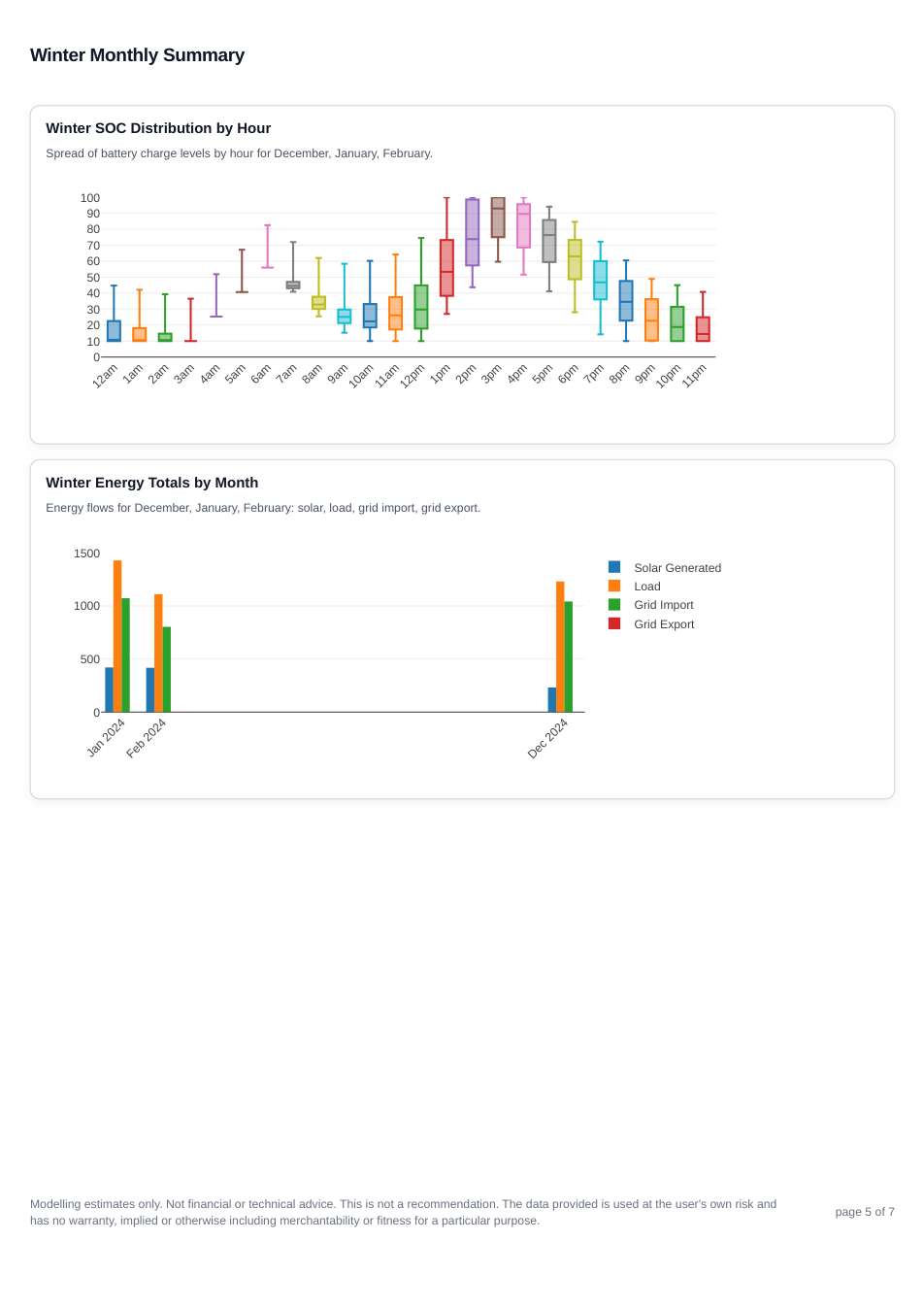
- 22.6% of winter load met by PV and batteries
- About £2,227/year total benefit from solar and battery
- Modelled electricity bill of about £1,089/year including standing charge
Comparison
£3,096/year cost
12,333 kWh annual load including the heat pump, all of it effectively bought from the grid.
£1,089/year bill
9,432 kWh generated, 5,675 kWh imported, 696 kWh exported, and 54.0% annual coverage.
Average import 16.8 p/kWh
The current import already averages about 16.8 p/kWh, close to 15 p/kWh off-peak rate.
Why winter matters
The system already has a serious battery system. The tell-tale sign is the import bill. The model shows £953 of import cost across 5,675 kWh, which works out at roughly 16.8p/kWh on average. That tells me the Cosy charging strategy is already doing a lot of the cost-control work. What's more the SOC in winter remains high enough throughout the day.
Charge-rate bottleneck
With off-peak charging twice a day and only a 3.6 kW import charge rate, the inverter can only pull in ~10 kWh in any single charge period.
That means the existing batteries already look adequate to cover a significant part of the winter load. The inverter has a 3.6 kW import capacity so it cannot charge enough in the allocated period, which is why the winter SOC chart matters more than simply adding more nominal storage.
Install?
What would I do
There would potentially be a case for bigger batteries if a single off-peak longer charge window were available such as the case with an EV tariff.
However, as the tariff is a heat pump one, with multiple off-peak windows throughout the day the analysis shows:
- The inverter is limited to charge at 3.6 kW so the batteries cannot charge anymore than they do in the allocated charge window.
- Even if there were longer charge windows (or higher capacity), the average import rate is ~16.8 p/kWh which is really close to the off-peak rate. Showing that the majority of energy is imported at the off-peak rate already. Any further opportunity to reduce this is minimal.
Adding more batteries to the system does not present itself as a financially viable investment.