Introduction
For this kind of modest home solar system, the short answer is that a small battery can be worth considering, but it is not automatically essential. Going without storage still gives a useful saving, while adding a battery mainly changes where the value comes from: less exported daytime solar, less grid import in the evening, and a shorter payback if cheap off-peak electricity is available.
This case study compares four modelled choices: solar with no battery, solar with a small battery on a standard import-export tariff, the same battery using an off-peak tariff with night charging, and a battery-only case with no solar on Economy 7. The site, annual electricity use, solar array, and inverter stay the same across the solar scenarios so the comparison focuses on whether storage changes the bill enough to justify the extra hardware.
The results show the modelled bill, import and export energy, self-consumption, and simple battery payback. That makes the article useful for deciding whether to buy a small solar battery now, wait for cheaper hardware, or keep the system simpler and rely on export payments instead.
These reports were modelled using our solar calculator: open the free Solar Butter solar calculator, which is free to use with no sign up required.
Methods
Study design
Four historic simulations were run in Solar Butter for one Gloucestershire home across the 2025 calendar year. Scenario 4 has no solar, a 10 kWh battery, and Economy 7 night charging. The other runs share annual household demand, solar array, inverter size, location, and standing charge. Table 1 lists the fixed inputs and scenario differences.
Analysis
The comparison uses the summary figures from each report: solar generation, grid import, grid export, total modelled benefit, modelled bill including standing charge, annual self-consumption, and winter self-consumption. Incremental benefit means the extra annual benefit compared with the no-battery case. Simple payback divides the illustrative £1,500 battery pack price by that incremental benefit; installation, VAT, inverter work, battery degradation, and cycle count are not included. The weather input is modelled as an hour-by-hour average, so short cloud events and second-by-second battery behaviour are outside the scope of this calculation.
| Parameter | Scenario 1 (no battery) | Scenario 2 (battery) | Scenario 3 (battery & night charge) | Scenario 4 (battery only) |
|---|---|---|---|---|
| Site location | Gloucestershire, UK | Gloucestershire, UK | Gloucestershire, UK | Gloucestershire, UK |
| Simulation period | 2025 | 2025 | 2025 | 2025 |
| Annual load | 3,500 kWh | 3,500 kWh | 3,500 kWh | 3,500 kWh |
| Solar array | 3.6 kW (8 × 445 W) | 3.6 kW (8 × 445 W) | 3.6 kW (8 × 445 W) | None |
| Inverter | 5 kW | 5 kW | 5 kW | 5 kW |
| Battery | None | 5 kWh | 5 kWh | 10 kWh |
| Tariff | 28p import, 12p export | 28p import, 12p export | 15p / 30p import, 12p export | 15p / 30p import |
| Night charging | No | No | Yes | Yes |
| Daily standing charge | 60p/day | 60p/day | 60p/day | 60p/day |
Results
The four report summaries show the practical trade-off. No battery gives the simplest system but exports the most solar. A small battery on the standard tariff cuts imports sharply. Adding off-peak night charging produces the lowest modelled bill, even though it deliberately imports more energy at cheap times. The full reports can be downloaded below, and the aggregate comparison is shown later in the Discussion.
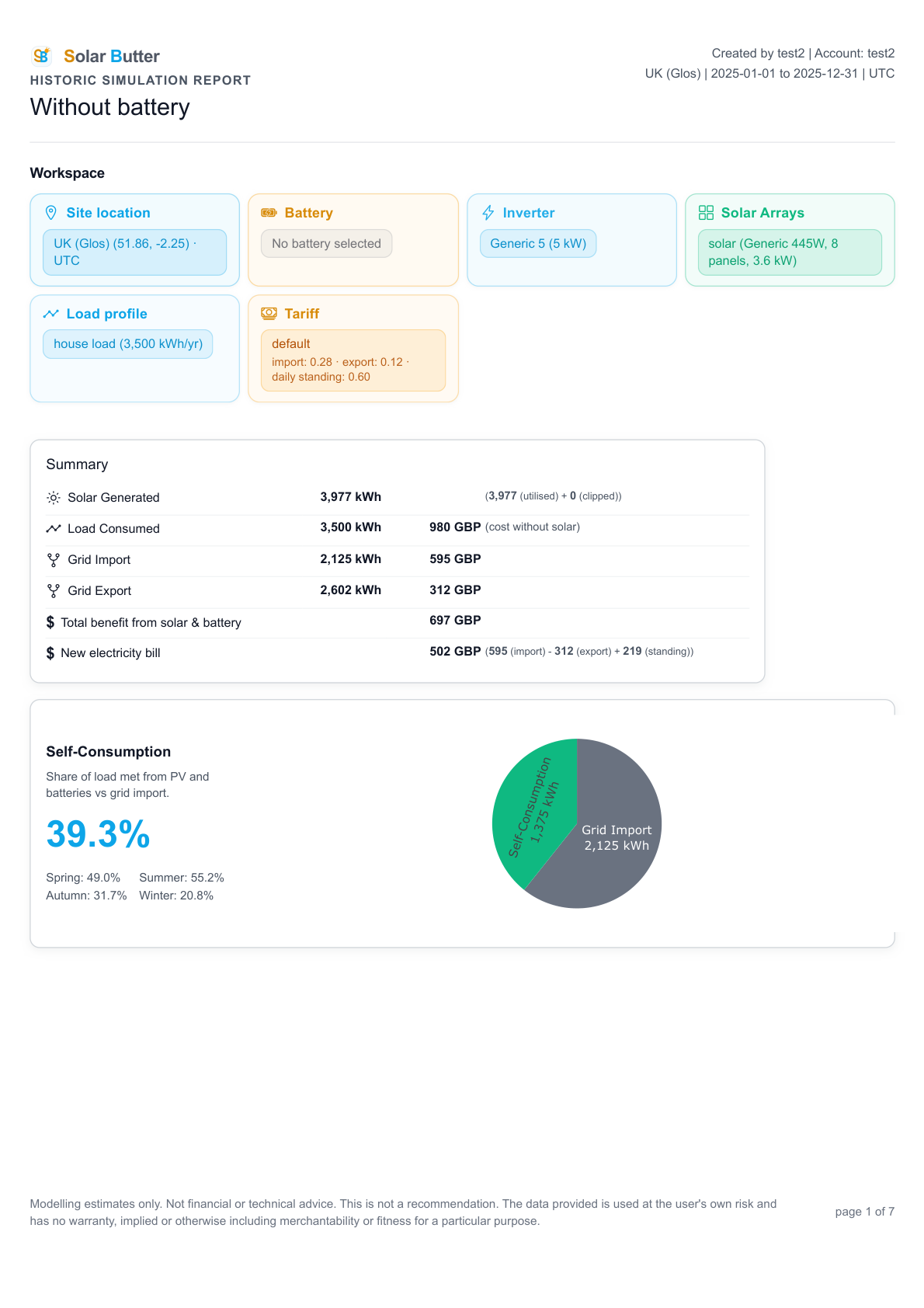
Scenario 1: No battery
This is the keep-it-simple option: solar only, no home storage, and no night charging. It still gives a meaningful annual saving, but much of the summer surplus leaves the house as export. That makes the result more dependent on the export price paid for unused daytime generation.
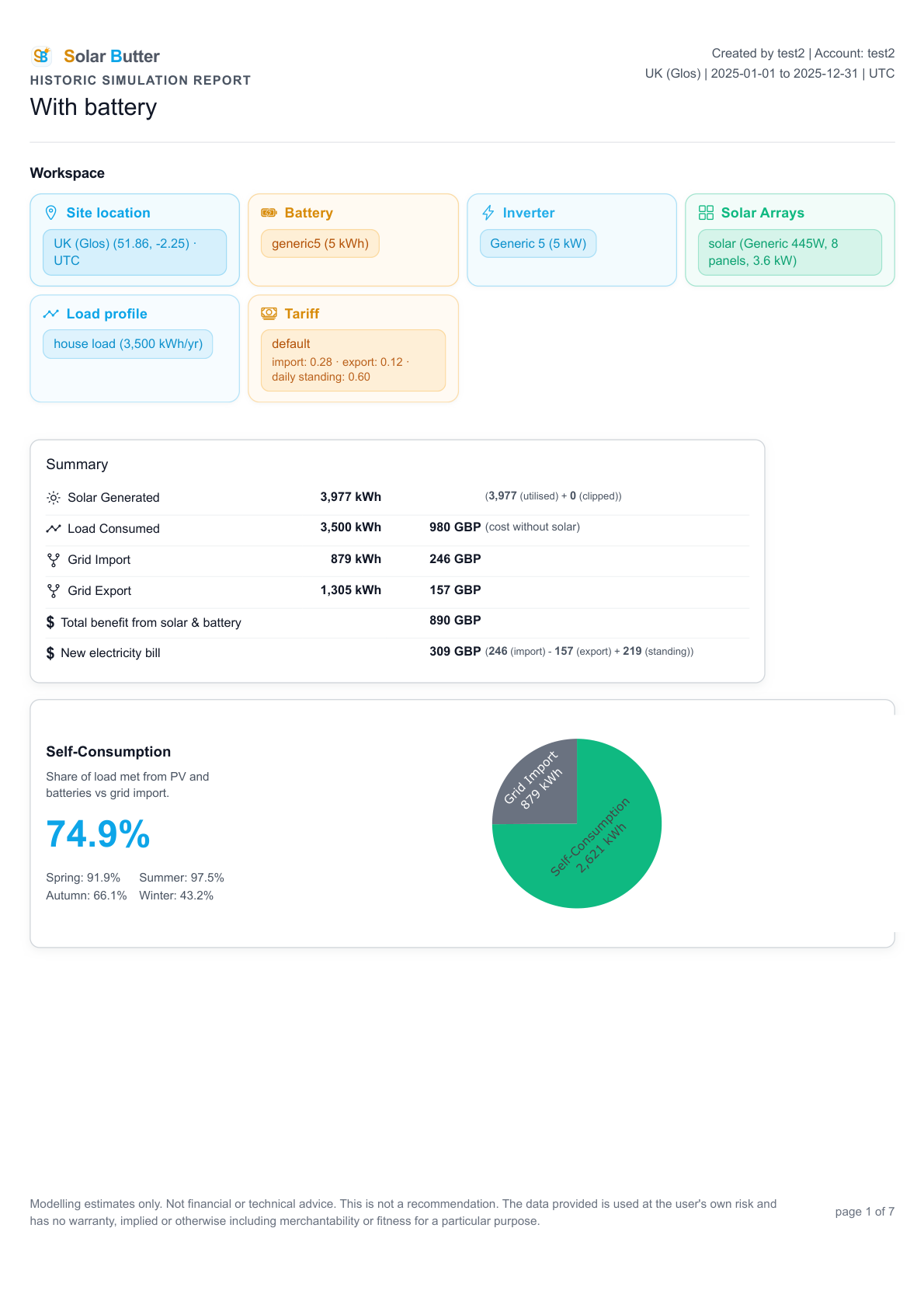
Scenario 2: With battery (default tariff)
Adding the battery on the same standard tariff shifts more solar into the evening and reduces grid import substantially. This is the cleanest test of whether a small battery earns its keep from solar self-consumption alone, without relying on a special import tariff.
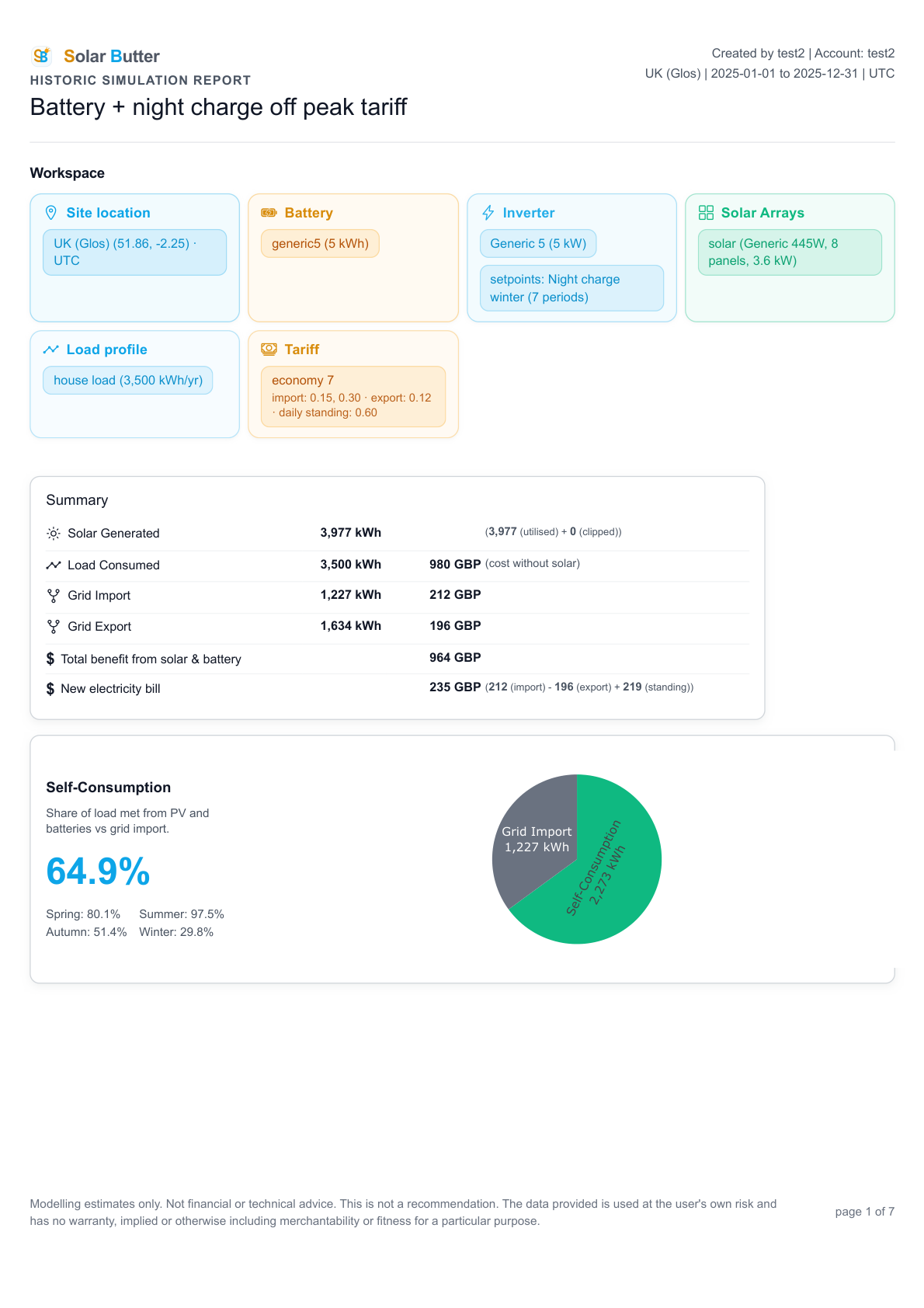
Scenario 3: Battery with off-peak grid charging
The off-peak case uses the same battery but lets it charge from the grid at night. It imports more electricity than the standard-tariff battery case, but more of that import is bought at the cheaper rate, which is why the modelled bill falls further. This setup is most attractive where a household can access a reliable cheap-rate tariff and configure the battery to use it well.
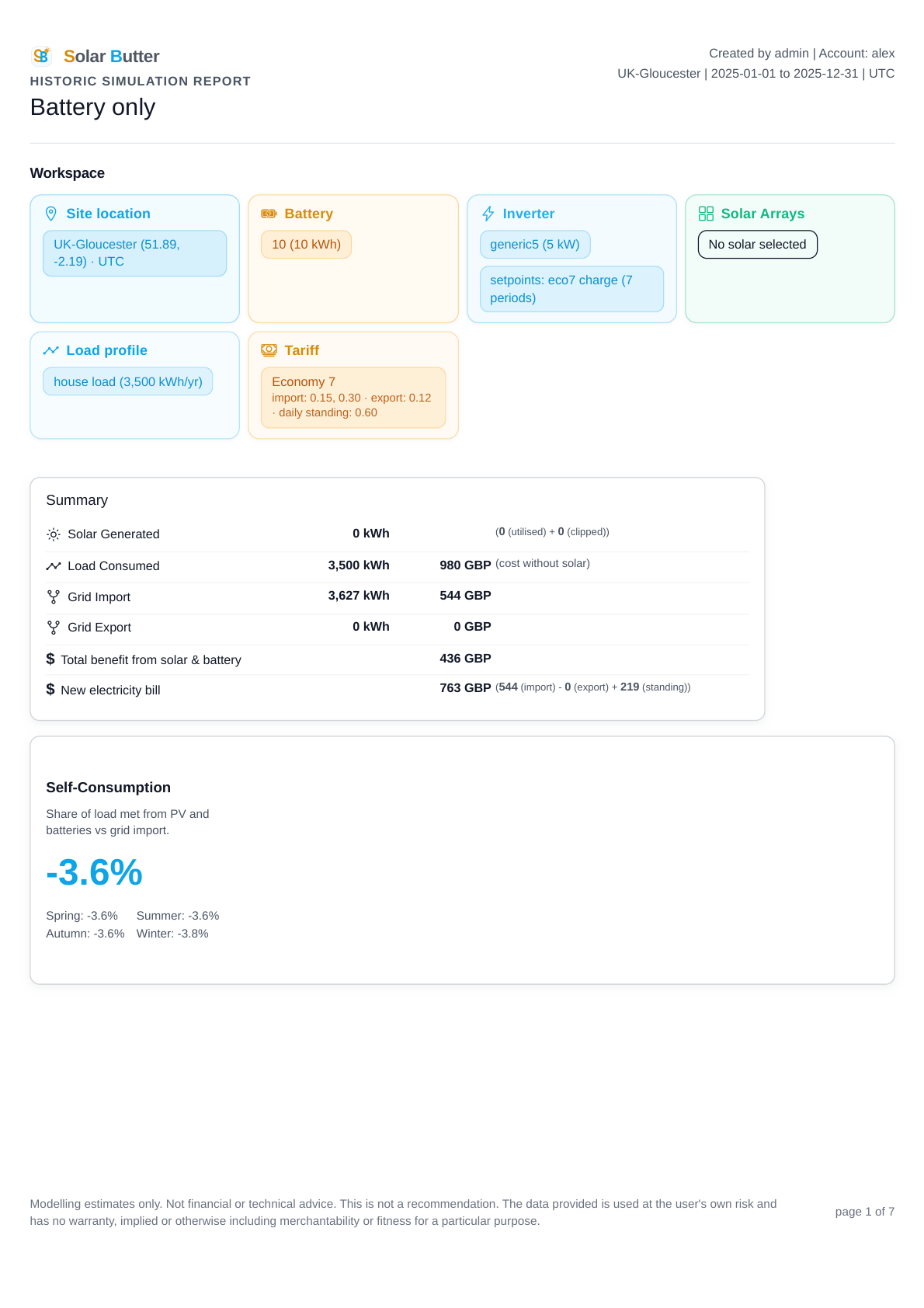
Scenario 4: Battery only (no solar)
No solar panels - tariff-shifting only on Economy 7. The home imports more kWh than it uses because of charging losses.
Discussion
The answer is not simply "battery good" or "battery bad". In this model, solar without a battery is still the lowest-complexity option and saves a meaningful amount each year. The standard-tariff battery improves the bill by using more of the home's own solar instead of exporting it. The off-peak charging case goes further because when electricity is imported becomes almost as important as how much electricity is imported.
£697/year saving
Modelled bill £502/year · 2,125 kWh grid import · 39.3% self-consumption · 2,602 kWh export
£890/year saving
Modelled bill £309/year · 879 kWh grid import · 74.9% self-consumption · 1,305 kWh export
£964/year saving
Modelled bill £235/year · 1,227 kWh grid import · 64.9% self-consumption · 1,634 kWh export
£436/year saving
Modelled bill £763/year · 3,627 kWh grid import · -3.6% self-consumption
| Metric | Scenario 1 (no battery) | Scenario 2 (battery) | Scenario 3 (battery & night charge) | Scenario 4 (battery only) |
|---|---|---|---|---|
| Solar generated | 3,977 kWh | 3,977 kWh | 3,977 kWh | 0 kWh |
| Grid import | 2,125 kWh | 879 kWh | 1,227 kWh | 3,627 kWh |
| Grid export | 2,602 kWh | 1,305 kWh | 1,634 kWh | 0 kWh |
| Total benefit | £697 | £890 | £964 | £436 |
| Modelled bill | £502 | £309 | £235 | £763 |
| Self-consumption (annual) | 39.3% | 74.9% | 64.9% | -3.6% |
| Winter self-consumption | 20.8% | 43.2% | 29.8% | -3.8% |
| Cost without solar | £980 | £980 | £980 | £980 |
Scenario 2 has the highest annual self-consumption because the battery is mainly absorbing surplus daytime solar and releasing it later in the home. That is the classic reason to buy a solar battery: less import, less export, and more use of the electricity the panels have already generated. On the default tariff, winter self-consumption rose from 20.8% to 43.2% when storage was added, which shows the battery still helps outside the best summer months.
Scenario 3 has lower self-consumption than Scenario 2 but the lowest modelled bill. That is not a contradiction: night charging deliberately increases grid import, but shifts more of that import into cheaper periods. For a household that can access a reliable off-peak tariff, a small battery is not just a solar storage device; it is also a tariff-shifting tool.
Scenario 4 saves vs grid-only (£980 → £763) but less than any solar scenario. Average import cost is about 15.5p/kWh (£544 ÷ 3,500 kWh), near the 15p off-peak rate.
Export income is the main reason the no-battery option still looks respectable. Under Smart Export Guarantee arrangements, however, export rates are supplier-specific and may change over time (Ofgem, 2024). Scenario 1 exported 2,602 kWh in the model, so more of its economics depends on being paid well for surplus generation. The battery cases export less, which reduces exposure to future export-price changes but also means the value depends more on household timing: daytime occupancy, evening demand, and tariff choice can all move the result.
Payback by scenario
Payback here means how long it takes a battery pack to earn back its cost from the extra annual saving. Scenarios 2–3 compare vs solar only (Scenario 1); Scenario 4 compares vs grid-only. Table 3 summarises the three battery setups. It is a useful screening metric, but it is not a complete investment model because it excludes degradation, inflation, and any future tariff changes (increases).
Battery price is obviously an important factor. If the hardware cost per kWh is low, the economics can improve, especially on larger batteries where the unit cost of storage may be lower. That does not mean a bigger battery is automatically better: usable capacity, inverter compatibility, installation cost, warranty terms, and how much electricity the home can actually shift all matter.
| Setup | Extra saving | Years to pay back |
|---|---|---|
| Battery, standard tariff (5 kWh, vs solar only) | £193/year | ~8 years (£1,500) |
| Battery + off-peak night charge (5 kWh, vs solar only) | £267/year | ~6 years (£1,500) |
| Battery only, no solar (10 kWh, vs grid-only) | £436/year | ~7 years (£3,000) |
Battery service life and cycling
LiFePO4 cells are widely used in residential batteries because they offer stable thermal behaviour and long cycle life relative to many nickel-based chemistries at comparable depth of discharge (Dubarry et al., 2017). That matters for payback: a battery only makes financial sense if it is likely to remain useful beyond the time it takes to recover its cost.
The simple payback periods in Table 3 sit within a plausible service-life window for good LiFePO4 hardware, but the warranty is still worth reading carefully. Night charging can improve the bill by cycling the battery more often, which may increase annual throughput compared with solar-only charging. Cycle limits, usable capacity, operating temperature, and installation quality should therefore be checked before using the payback figure as a buying decision.
Limitations
This is a modelled case study for one Gloucestershire site and one historic weather year. A different roof pitch, orientation, shading pattern, location, or weather year would change the generation profile and therefore the battery value. Treat the figures as a worked example, not as financial or installation advice for every home.
The simulation uses averaged hourly weather data. That is suitable for comparing broad annual outcomes, but it cannot fully capture partly cloudy days, short spikes in household demand, or second-by-second battery behaviour. Real batteries may cycle differently from the model, which can affect savings and payback.
Battery lifespan and capacity fade were not simulated. Actual endurance depends on the chemistry, warranty, usable depth of discharge, operating temperature, inverter settings, and installation quality. A good LiFePO4 battery with a clear warranty is a stronger candidate for this kind of payback calculation than an unknown pack with vague cycle-life claims.
Tariff and cost assumptions are also site-specific. Economy 7 and other cheap-rate tariffs depend on supplier, meter type, region, and eligibility, while export rates can change. Installed cost may include electrical work, inverter compatibility checks, commissioning, VAT, and warranty requirements, so a real quote can move the result materially.
Conclusion
For this modelled home, a 5 kWh solar battery is a good option at the illustrative £1,500 hardware cost. Solar without a battery still produces a useful saving, but adding storage increased the modelled benefit from £697/year to £890/year on the standard tariff and £964/year with off-peak night charging. On the Table 3 assumptions, that gives a simple payback of about ~8 years for the standard-tariff battery case and about ~6 years when cheap-rate night charging is used.
The case becomes stronger if a cheap off-peak tariff is available, because the battery can shift both spare solar and low-cost night electricity into the hours when the home needs it. For a small UK solar system, that makes the battery most attractive when the installed price is sensible, the warranty is strong, and the household can use the battery to avoid expensive peak-rate imports.
Export tariff uncertainty is another strong reason to favour a battery. A no-battery system depends more heavily on being paid well for surplus daytime solar, but Smart Export Guarantee rates are supplier-specific and can change. Recent trends in export pricing show why it is risky to assume today's export tariff will remain available for the life of the solar system. Using more generation at home gives the household more control and makes the economics less exposed to future export-rate cuts.
A battery without solar can shift off-peak electricity, but solar delivers more benefit in this model.
References
- Dubarry, M., Devie, A., Liaw, B.Y. and Dodd, M. (2017) 'Evaluation of commercial lithium-ion cells for long-term grid energy storage applications', Journal of Power Sources, 361, pp. 300–307.
- Holmgren, W.F., Hansen, C.W. and Mikofski, M.A. (2018) 'pvlib python: a python package for modeling solar energy systems', Journal of Open Source Software, 3(29), p. 884. doi:10.21105/joss.00884.
- IEA PVPS Task 16 (2018) Best Practice Guidelines for the Validation of Solar Simulation Models. IEA PVPS T16-04:2018.
- MCS (2024) MIS 3003 Issue 4.3: Battery Energy Storage System Installation Standard. Microgeneration Certification Scheme.
- Ofgem (2024) Smart Export Guarantee: Guidance for Generators. Office of Gas and Electricity Markets.
- Fogstar Energy (2026) Fogstar Energy 16.1 kWh 48 V LiFePO4 solar battery. Recommended retail price £1,949 (hardware only, installation not included). Fogstar Energy UK.