Introduction
The cost of running a heat pump depends heavily on where the home is. A colder climate asks the heat pump to work harder for longer, especially through winter. A sunnier climate gives the solar panels and battery more energy to work with. Those two effects can pull the annual bill in very different directions, even when the house, heat pump, panels, battery, and tariff are kept the same.
For this comparison, the house is deliberately ordinary: a three-bed semi-detached home with cavity wall insulation, broadly typical of something built around the 1970s or 1980s. That gives a useful baseline, but it is not meant to represent every property. A newer home, a large detached house, a solid-wall property, or a home with different insulation could land somewhere quite different, which is why the Solar Butter simulator can be used to estimate other housing types and property ages.
The model then keeps the main setup consistent across several locations: a typical household load, a heat pump, 10 south-facing solar panels, and a battery. Holding those assumptions steady makes the regional pattern easier to see. Colder places tend to need more grid electricity, while sunnier places tend to get more help from solar.
The headline results show the spread. London comes out at about £919/year after solar PV, battery, export credit, and standing charge. Glasgow is about £1,303/year on the same tariff, while California reaches about -£27/year in this model because heat demand is much lower and solar output is much stronger.
These figures should be read as a fixed-tariff baseline, not the lowest possible bills. A dedicated heat pump tariff, off-peak battery charging, and smarter winter scheduling can reduce the quoted bills further. We cover that strategy in the heat pump tariff versus EV tariff case study.
These reports were modelled using our solar calculator: open the free Solar Butter solar calculator, which is free to use with no sign up required.
Assumptions
- 2025 weather year for each location
- 100 m2 home with 5.5 kW heat loss at the design outside temperature, broadly typical of a 1970s-1980s three-bed semi-detached home with cavity wall insulation
- Same heat pump model, 45C design flow temperature, 200 litre hot-water tank, and 2 occupants
- 2,800 kWh/year non-heat-pump household electricity load
- 10 south-facing Jinko Tiger Neo 445 W panels, about 4.5 kW total
- Fox ESS H1-5.0-E 5 kW inverter and 10 kWh battery
- Fixed tariff: 28p import, 12p export, 60p/day standing charge
- All regions use the same tariff, so different local electricity prices are not considered
- Heat pump tariffs, off-peak charging, and tariff optimisation are not included
That last point matters. Electricity rates can be cheaper or more expensive in Europe, California, or different parts of the UK. This comparison deliberately holds the tariff constant so the result is about weather, heat demand, solar generation, and self-consumption, not local energy-market pricing.
The heat pump and household cost columns below are energy-only costs at 28p/kWh. The combined bill column is the full report output: grid import minus export income, plus the standing charge.
In practice, the same solar and battery system could be run differently. Off-peak charging and heat pump tariffs can shift more winter electricity away from peak prices, which is why the figures here should be read as a fixed-tariff baseline rather than the cheapest possible setup.
For a different property age, floor area, insulation standard, or house type, use the Solar Butter simulator to adjust the heat loss and load assumptions before comparing regions or tariffs.
Scenario 1: London
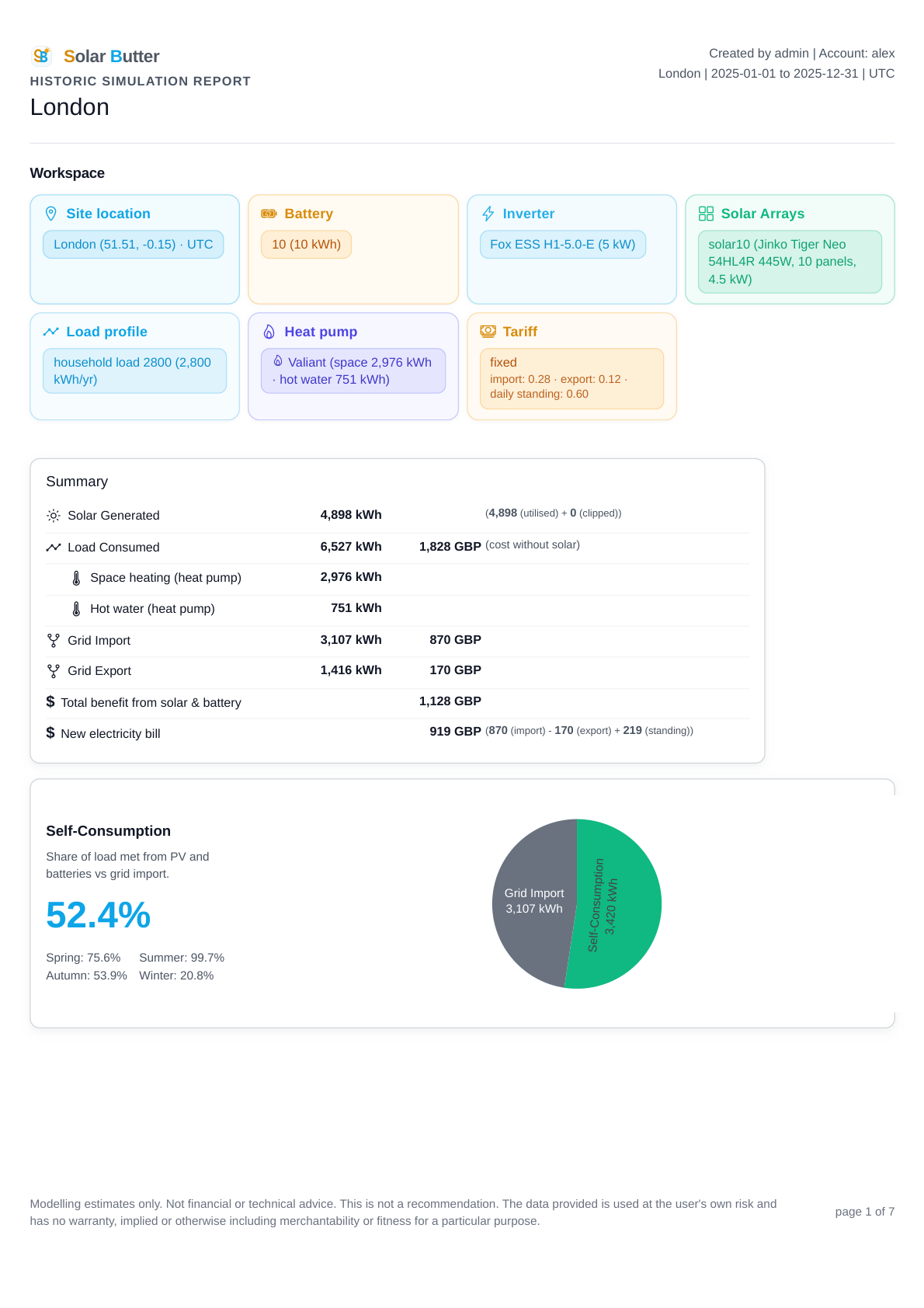
Outputs
- 3,727 kWh/year heat pump electricity demand
- 6,527 kWh/year total load once household use is included
- 4,898 kWh/year solar generation from the 10-panel south-facing array
- 3,107 kWh grid import and 1,416 kWh grid export
- 52.4% of annual load met from PV and battery
- £1,128/year total benefit from solar and battery
- £919/year modelled electricity bill including standing charge
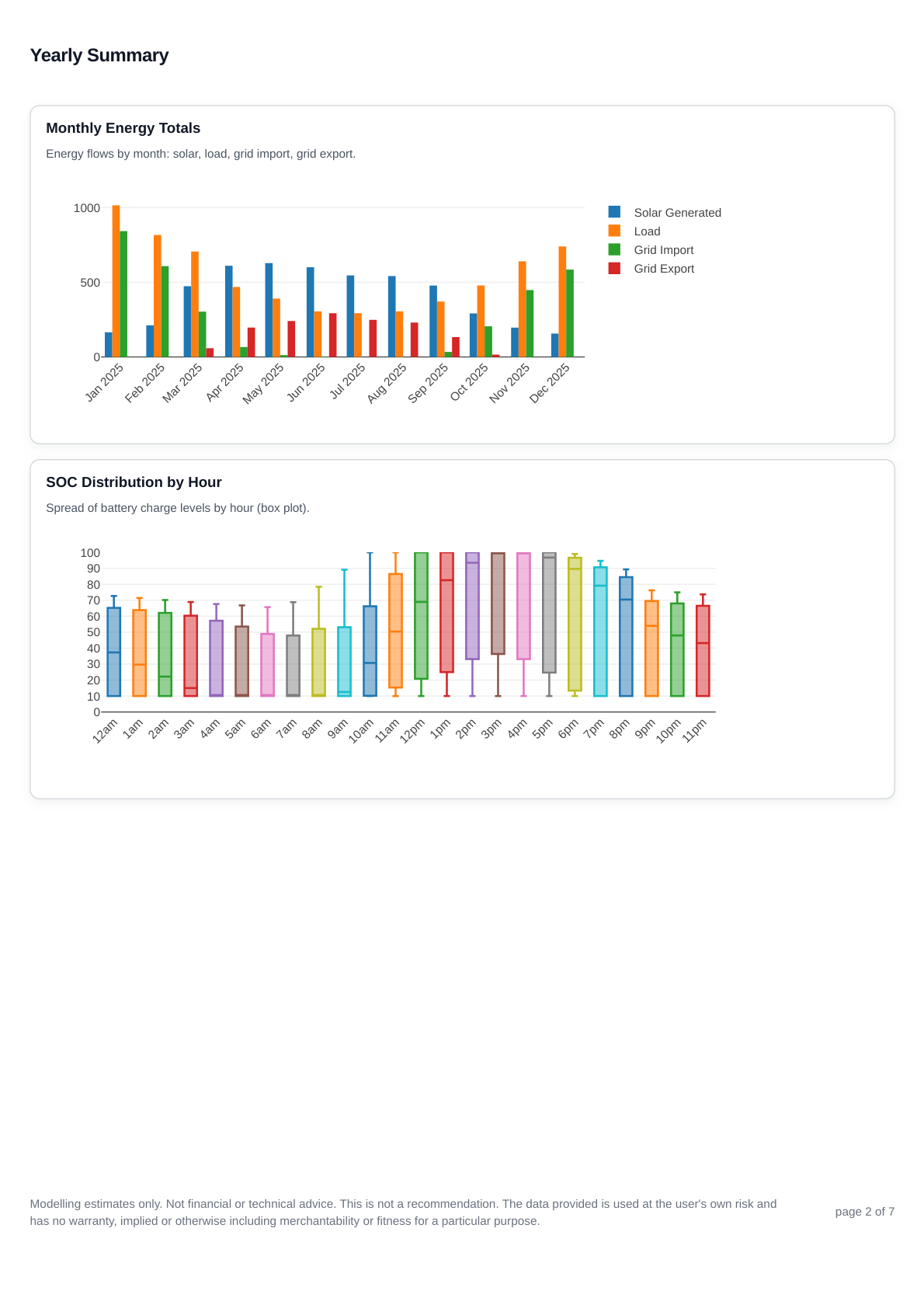
London is a useful middle case for a UK reader. The heat pump is doing meaningful winter work, but the climate is milder than Scotland and the solar yield is stronger than Glasgow. The battery helps by catching daytime solar and serving evening load, but the winter mismatch remains visible.
Scenario 2: Glasgow
Outputs
- 4,841 kWh/year heat pump electricity demand, about 1,114 kWh more than London
- 7,640 kWh/year total load once household use is included
- 4,391 kWh/year solar generation, about 507 kWh less than London
- 4,294 kWh grid import and 987 kWh grid export
- 43.8% of annual load met from PV and battery
- £1,055/year total benefit from solar and battery
- £1,303/year modelled electricity bill including standing charge
£919/year bill
3,727 kWh heat pump use, 4,898 kWh solar generated, 52.4% load covered by PV and battery.
£1,303/year bill
4,841 kWh heat pump use, 4,391 kWh solar generated, 43.8% load covered by PV and battery.
About £384/year
Colder weather adds heat pump load while lower solar yield reduces on-site coverage.
Glasgow is more expensive for two linked reasons. First, colder temperatures increase space heating demand, so the heat pump consumes more electricity. Second, solar production is lower, and winter solar arrives when days are short and the heat pump is working hardest.
That is why the combined bill gap is larger than a simple solar-yield comparison. Glasgow has more load to serve and less generation to serve it with, so it imports more from the grid and exports less in the annual model.
Regional cost comparison
| Region | Heat pump use | Heat pump cost alone | Household cost alone | Solar yield | Solar + battery benefit | Combined bill with house load + solar + battery | Report downloads |
|---|---|---|---|---|---|---|---|
| Glasgow | 4,841 kWh/year | £1,355/year | £784/year | 4,391 kWh/year | £1,055/year | £1,303/year | |
| Gloucester / UK | 4,215 kWh/year | £1,180/year | £784/year | 4,990 kWh/year | £1,154/year | £1,029/year | |
| London | 3,727 kWh/year | £1,044/year | £784/year | 4,898 kWh/year | £1,128/year | £919/year | |
| Paris | 3,828 kWh/year | £1,072/year | £784/year | 5,307 kWh/year | £1,184/year | £891/year | |
| Marseille / South France | 2,098 kWh/year | £587/year | £784/year | 6,893 kWh/year | £1,437/year | £154/year | |
| California | 1,339 kWh/year | £375/year | £784/year | 6,644 kWh/year | £1,405/year | -£27/year |
The pattern is clear: heat pump consumption rises in colder places, while solar yield improves in sunnier places. The same equipment therefore produces very different bills even before considering local electricity rates.
Conclusion
So, how much does it cost to run a heat pump? In this model, the heat pump alone uses about 3,727 kWh/year in London, costing about £1,044/year at 28p/kWh before standing charge. In Glasgow it uses 4,841 kWh/year, costing about £1,355/year on the same energy rate.
Adding 10 south-facing solar panels and a 10 kWh battery changes the whole-house bill, but it does not remove the climate effect. London falls to about £919/year after solar and battery. Glasgow is still about £1,303/year because it has higher heat demand and lower solar yield. Marseille and California look much cheaper in this model because their heat demand is lower and annual solar generation is much stronger.
Use these results as a modelled comparison, not a promise. The reports use averaged hourly weather data, a fixed tariff, and one house specification. A real home can change the answer with better insulation, different flow temperatures, a different tariff, or a different roof. To test your own numbers, run the scenario in the Solar Butter solar calculator.